
The case: the attacks and the emergency ordinances
In the first weeks of August, the area of Noicattaro, within the Bari Metropolitan City, was affected by two serious incidents: on the evening of 4 August, an attack by dogs on two minors, and on the evening of 15 August, a second incident, again involving a minor. This was followed by intense institutional activity — technical meetings at the Prefecture, a dedicated task force, a request to capture the animal forwarded to the Ministry by the relevant regional offices — and a series of urgent mayoral ordinances: no. 228 of 12 August, later supplemented and extended by no. 230 of 17 August and subsequently by no. 231.
Among other things, the measures ordered the night-time closure of the Municipal Park and restricted access to green areas near farmland and the Lame (ravine) areas. So far, understandable and proportionate measures for a situation the municipality itself described as an emergency.
The problem: a ban worded too broadly
Among the rules addressed to residents, however, one was bound to create confusion: the instruction “not to distribute food for domestic animals outside homes”.
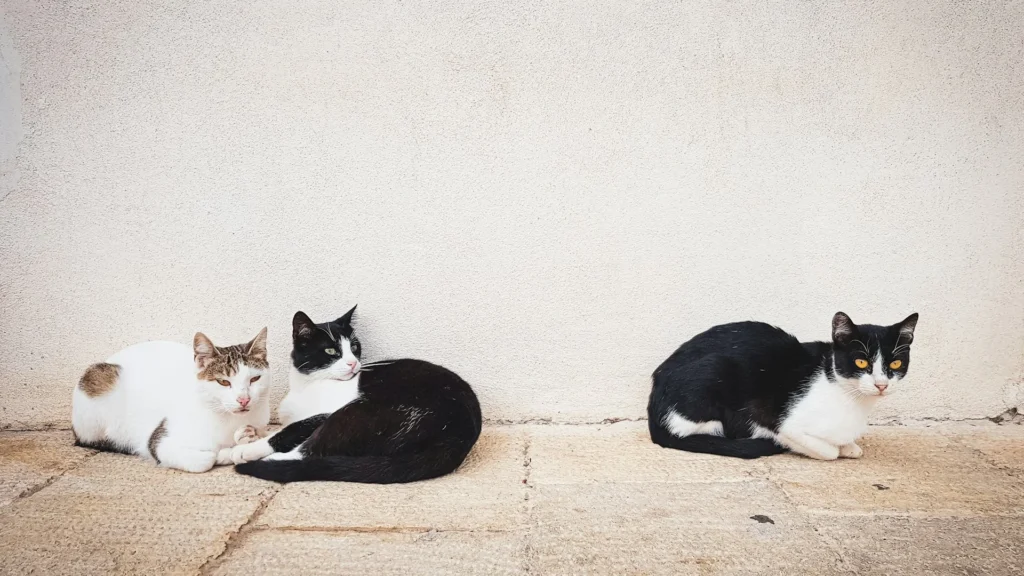
Read literally, such a broad wording could also have been applied to the feeding of registered cat colonies and of dogs released back into the area under the regional law — activities that are not a mere courtesy towards animals, but lawful conduct, recognised and regulated by law. Indeed, some residents and volunteers had already understood the ban in this way, with the real risk that the registered community cats in the area would be left without food or water, and that caretakers would face complaints even while acting in full compliance with the rules.
There was also a practical paradox: suspending controlled feeding does not make the animals “disappear”. On the contrary, it pushes them to leave their usual sites and wander in search of food towards homes, businesses and bins — exactly what an ordinance aimed at protecting public safety is meant to prevent.
Rete Felina’s intervention
Yesterday, 19 August, as part of the Rete Felina project, Animal Law Italia sent the mayor, the Local Police Command and the Veterinary Service of the local health authority (ASL) — with copy to the Prefecture of Bari and the Puglia Region — a request for clarification and for the ordinance to be supplemented.
The letter, deliberately written in a collaborative tone, did not challenge the purpose of the measure: it asked for clarification that the ban does not apply to the feeding of registered cat colonies and of dogs released back into the area, and for the correct methods of feeding to be specified (designated spots, daytime hours, bowls with leftovers removed after feeding), to be agreed with the ASL and with colony caretakers.
The municipality’s response: the ban does not apply to cat colonies
The response came very quickly. In a letter sent in the early hours of this morning, 20 August, signed by Mayor Raimondo Innamorato and the Local Police Commander Luca Pinto, the municipality provided the requested clarifications, confirming “this municipal administration’s full willingness to engage in constructive and collaborative dialogue for the protection of urban wildlife and the local area”.
Two passages matter, and the municipality even chose to highlight them in the text:
- the instruction not to distribute food outside homes “is strictly intended to prevent food being abandoned unattended on the ground, the permanent presence of bowls, dishes or containers scattered on the ground, and any situation of neglect”, conduct that poses a danger to public safety;
- “this ordinance does not apply to properly registered cat colonies”.
This is exactly the clarity we had asked for: the ban targets the indiscriminate abandonment of food, not the responsible feeding of animals that live freely in the area under the law.
A response not entirely in line with the law
The only criticism we can raise is that the ability to continue feeding the animals is expressly limited to colonies that are “properly registered”, even though Puglia’s regional legislation does not make the protection of free-roaming cats conditional on any prior formality.
We trust this was an oversight, also due to the ongoing emergency, and that it will be applied correctly, so as to include all free-roaming cats, who as such — without the need for any specific bureaucratic steps — are protected by law.
The laws protecting free-roaming cats and those who care for them
The Noicattaro case is an opportunity to restate some fixed points, valid well beyond this single case.
The national framework law (Law 281 of 14 August 1991, Italy’s framework law on companion animals and stray animal prevention) protects cats living freely and establishes that they cannot be removed from their habitat: colonies cannot be moved or dispersed, which means the animals must be able to be cared for where they live.
In Puglia, regional law no. 2 of 7 February 2020 defines the cat colony caretaker precisely as “the individual who looks after the care and feeding of the cat colony” (art. 2, para. 1, letter m): feeding a group of free-roaming cats is therefore not a tolerated activity, but the very substance of the role the law recognises for caretakers. The same law prohibits anyone from mistreating free-roaming cats or removing them from their habitat (art. 13), and Regional Regulation no. 14/2023 completes this framework. Systematically depriving free-roaming cats and dogs released back into the area, who cannot be removed, of food and water can also amount to a criminal offence, under articles 544-ter and 727 of the Criminal Code.
An urgent mayoral ordinance, however lawful, is by nature temporary and exceptional: it may regulate how feeding is carried out, but it cannot result in a blanket ban that strips away rights and duties established by national and regional law.
What this means in practice for colony caretakers
The municipality’s clarification gives practical guidance useful to all caretakers, in Noicattaro and elsewhere, especially when emergency measures are in force:
- continuing to feed a cat colony, whether registered or not, is lawful, and no complaint can be raised against anyone doing so correctly;
- food should never be left unattended on the ground: it should be given in bowls or containers, preferably during daytime hours and at fixed spots;
- after feeding, bowls and leftovers should be removed: it is precisely the permanent presence of containers and leftovers that these ordinances aim to prevent, including to avoid attracting wildlife.
Credit should be given to the Noicattaro administration for responding promptly and in a spirit of collaboration, at an objectively difficult time for the community. This shows that public safety and animal welfare are not opposing interests: they are better protected together, with clear rules.
In any case, registering a colony remains strongly recommended in every region, as it is a prerequisite for neutering and therefore for keeping the cat population from growing uncontrolled: if your colony is not yet registered, request recognition according to the rules set at regional level.
If you care for a cat colony and an ordinance or measure in your municipality calls into question your ability to feed it, Rete Felina can help you: tell us about your case and we will support you in dealing with the authorities, including legal action where necessary.