
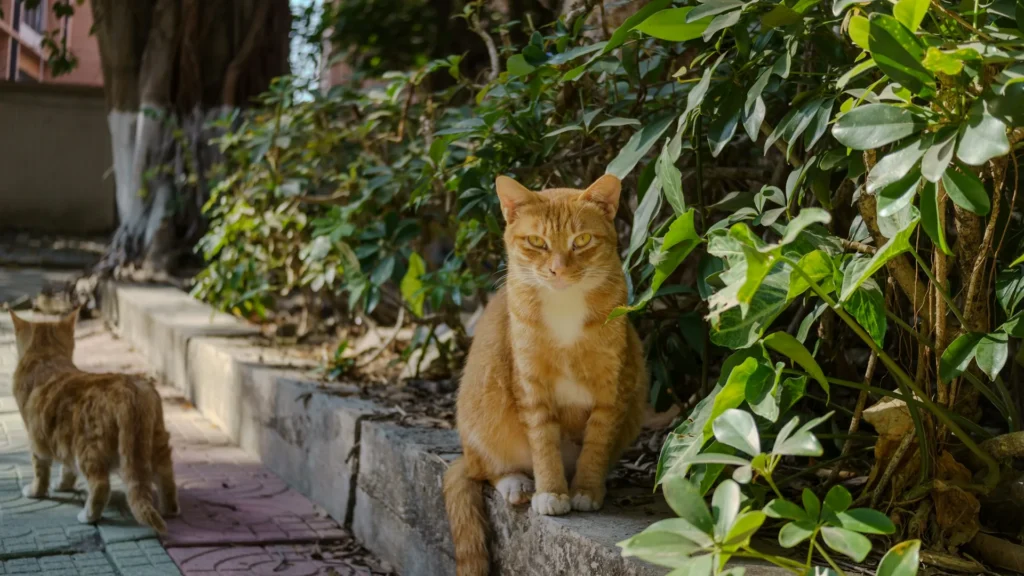
A cat colony can be recognised and registered even if it lives in a shared building’s grounds, and requesting its registration does not require a request from the building manager or a resolution of the residents’ meeting. The Puglia Region put this in writing, in a note dated 3 August 2026, responding to the formal notice that Animal Law Italia had sent to the local health authority (ASL) of Bari through the Rete Felina project. It is an important clarification for all the colony caretakers who look after community cats in courtyards, gardens and shared spaces of residential buildings.
The case: a colony stalled for over a year in Mola di Bari
The case concerns a cat colony settled in Mola di Bari (BA). In July 2025, the Local Police Command, after an inspection that had confirmed the free-roaming cat status of the animals, forwarded to the Veterinary Service of the ASL of Bari a request for recognition and neutering of the colony, complete with the registration form filled out on the ASL’s own template.
In October 2025, however, the ASL stated that it was “unable to proceed with recognising the colony, as it is declared to be located in a shared building’s grounds”, arguing that the request should have come from the building manager or at least been accompanied by their acknowledgement.
The Local Police responded point by point, noting that the location within a shared building does not prevent recognition and that involving the building manager is purely a matter of convenience, not a legal requirement. But the note went unanswered, as did the subsequent request for clarification sent in March 2026 by the Rete Felina project lead, Mariagrazia Distante. The result: over a year after the procedure began, the colony was still neither recognised nor registered, and the cats could not be neutered.
Animal Law Italia’s formal notice
The colony’s caretaker then turned to Rete Felina, Animal Law Italia’s project that connects colony caretakers, municipalities and local health authorities to ensure the correct application of the laws protecting community cats.
On 17 July 2026, Animal Law Italia sent a formal notice to the ASL of Bari, under articles 2 and 2-bis of Law no. 241/1990, requiring it to conclude the procedure within thirty days with an explicit decision recognising and registering the colony and to arrange for the neutering, warning that failing this it would bring the matter before the Regional Administrative Court (TAR) to have the authority’s duty to act formally established (articles 31 and 117 of the Code of Administrative Procedure).
In the formal notice, Animal Law Italia pointed out that no law, whether national or regional, makes the recognition of a cat colony conditional on a request from, or the approval of, the building manager: the Puglia regional law no. 2/2020 (in Italian) defines a cat colony’s habitat as “any urban area or part of it, public or private, built-up or not”, and case law has clarified that using a shared area as a colony’s territory falls within the lawful use of shared property under article 1102 of the Civil Code, without needing the other residents’ authorisation (Milan trial court, judgment no. 23693/2009).
The Region’s response: no grounds for refusal
The response came from the Puglia Region’s Department for the Promotion of Health and Animal Welfare, which fully accepted Animal Law Italia’s arguments, informing the ASL of Bari and the municipality that:
- Law no. 281/1991 protects free-roaming cats and establishes that they may not be removed from their natural habitat (article 2, paragraphs 7 and 8);
- Puglia regional law no. 2/2020 and Regional Regulation no. 14/2023 define a cat colony’s habitat as any urban area, “public or private”, where a colony of community cats lives permanently;
- the presence of a cat colony in a private or shared area of a residential building “falls within the lawful use of shared parts under article 1102 of the Civil Code”, and the law in force “does not make the colony’s recognition conditional on the approval of the acting building manager or on any resolution of the residents’ meeting”;
- there is therefore no obstacle to recognising the colony on Via Nino Rota and simultaneously registering it in the Regional Registry of Companion Animals, with the assignment of a unique colony identification code.
Finally, the Region pointed out that the colony caretaker must ensure compliance with hygiene and health rules and with the upkeep of public spaces when providing food and water, never leaving food out unattended and keeping the area clean (article 13, paragraph 6, regional law no. 2/2020).
Why this is good news for all colony caretakers
The Puglia Region’s response does not only resolve the Mola di Bari case: it sets a principle valid for all cat colonies living within shared buildings’ grounds. A refusal based on the shared nature of the area — or on the supposed need for the building manager’s consent — has no legal basis, and recognition is the precondition for the ASL to arrange neutering, the only effective and lawful way to manage the urban cat population.
This clarification also comes at a useful moment. By decree of 17 July 2026 — the very same day as the formal notice — the Region reconstituted the Regional Stray Animals Commission (in Italian), the advisory body to the Regional Council tasked under article 18 of regional law no. 2/2020 with coordinating and overseeing the law’s implementation. It would be important for the newly established Commission to also address this point, establishing for the whole region, in general terms, what the Region has already stated for the Mola di Bari case: no local health authority can make a colony’s recognition conditional on a building manager’s consent.
If you look after a cat colony and your municipality or local health authority is delaying recognition or raising similar obstacles, Rete Felina can help: tell us about your case and we will support you in dealing with the authorities, including legal action where necessary.