
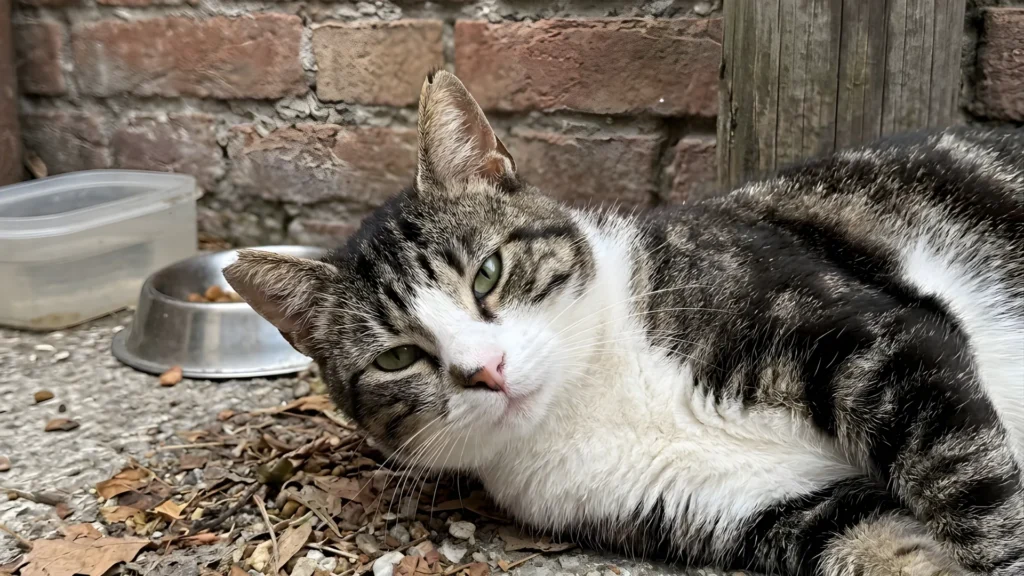
Have you ever noticed a free-roaming cat with the tip of one ear “clipped off”? It’s not the sign of a fight: it’s ear-tipping, the internationally recognised method for identifying at a glance cat colony members that have already been neutered. In this article we explain what it involves, why it matters so much for the welfare of free-roaming cats, what Italian law requires, and how our network steps in when, unfortunately, it isn’t carried out.
What ear-tipping is
Ear-tipping is the surgical removal of the tip of the outer ear (the pinna) — generally the left one. The cut is minimal — no more than 7 millimetres from the tip of the ear — but enough to make the cat instantly recognisable from a distance as already neutered, without needing to catch or handle it.
It is carried out by the veterinarian immediately after the neutering surgery, while the cat is still under deep anaesthesia: the animal therefore feels no pain, and wakes up with the identifying mark already in place, which heals within a few days.
Why it’s essential for free-roaming cats
Cat colony management programmes in Italy are based on the trap, neuter and return method (TNR): the cat is caught, neutered, and released back into its own territory. This system only works under one condition: that anyone who comes into contact with the animal can tell at a glance whether that cat has already been neutered.
Without ear-tipping, an already-neutered cat risks being:
- needlessly trapped again, with the stress this causes an unsocialised animal;
- put through a second general anaesthetic and an unnecessary surgical procedure, with the associated anaesthetic risks;
- a source of wasted public resources, since the veterinary service spends time and funds on a procedure that has already been carried out.
There’s also an aspect that is often overlooked: free-roaming cats can move around, and colony caretakers change over time. The identifiability of a neutered colony cat must be guaranteed to anyone, at any time — it cannot depend on the memory of whoever happens to look after the colony today, or on the hope that the cat won’t wander a few blocks away.
Is ear-tipping a mutilation? What the law says
It’s a fair question: the European Convention for the Protection of Pet Animals (ratified in Italy by law no. 201/2010) generally prohibits procedures that alter an animal’s appearance. Ear-tipping, however, is expressly allowed as an exception (art. 10, paragraph 2, letter a of the Convention), precisely because it is carried out in the animal’s own interest: it avoids repeated trapping and further surgery for purely identification purposes.
The main legal references are:
- the framework law of 14 August 1991, no. 281 (L. 281/1991, Italy’s framework law on companion animals and stray animal prevention), which entrusts local health authorities with neutering free-roaming cats and returning them to their colony of origin;
- the Ministry of Health notice – DGSAF prot. no. 766 of 17 January 2012, which sets out the national procedure: ear-tipping “must be performed immediately after the neutering surgery, with the animal under deep anaesthesia, in accordance with good veterinary practice,” with a cut no longer than 7 mm;
- regional laws on animal protection, which in many cases require identification to take place at the same time as neutering. In Calabria, for example, art. 13, paragraph 9, of regional law no. 45/2023 establishes that cats belonging to cat colonies, “at the same time as neutering, are identified and registered with the registry in the name of the relevant municipality.”
One point deserves particular emphasis: since ear-tipping can only be lawfully performed under deep anaesthesia, it is by its very nature something that must happen at the same time as neutering. Skipping it in the operating room means permanently ruling out visual identification of the animal — or condemning it to being trapped and anaesthetised all over again for the sole purpose of marking it. An unreasonable outcome that goes against the animal’s wellbeing.
Why relying on volunteers’ memory isn’t enough
Caretakers who look after cat colonies know their own cats. But the volunteers’ “visual memory” is not an identification system recognised by any law and cannot replace the one required by regulation. Permanent identification exists precisely to go beyond any single caretaker: it must still work in ten years’ time, even if the cat moves to another neighbourhood, even if that caretaker is no longer around. A public service cannot make compliance with a legal obligation dependent on the memory of private citizens.
We’ve been told it isn’t always carried out: how we step in
Unfortunately, the reports we receive from colony caretakers tell us that ear-tipping is not always performed at public clinics run by local health authorities during neutering.
This happened recently in Calabria: in July 2026 a caretaker reported to us that, at an ASP (local health authority) clinic, four cats from two officially registered colonies had been neutered without any of them receiving ear-tipping, with the clinic explaining that the volunteers “would remember” which cats had been operated on.
In cases like this, Rete Felina takes concrete action: through Animal Law Italia ETS, the organisation behind the project, we sent a formal report to the local health authority, asking it to confirm that the neutered cats had been identified and registered, to remind veterinary staff to follow the ministerial procedure, and to adopt a consistent operating procedure requiring ear-tipping every time a colony cat is neutered. Should there be no response, we have reserved the right to bring the matter to the attention of the Ministry of Health and the Region.
This is exactly the purpose of our project: connecting colony caretakers, municipalities and local health authorities to ensure the correct and consistent application of the rules protecting free-roaming cats, while offering legal support to the volunteers who care for them every day.
What to know about ear-tipping
No. It is performed under deep anaesthesia, immediately after neutering, and the small wound heals within a few days. The cat’s hearing and quality of life are not affected in any way.
As a rule, the left ear is used, with a clean cut no longer than 7 mm, as set out in Ministry of Health notice DGSAF no. 766/2012.
No, they’re complementary tools: the microchip allows unique identification of the individual animal and registration in the official registry, while ear-tipping allows recognition at a glance and from a distance, without needing to catch the cat. For free-roaming cats belonging to cat colonies, this is precisely its essential function.
If you’re a colony caretaker or volunteer, let us know: note down the date and place of the procedure, the colony’s registration code, and any communication received from the veterinary service. Rete Felina can help you send a formal report to the local health authority and the relevant bodies.
Do you have something to report? Contact us: we support colony caretakers free of charge in protecting free-roaming cats