
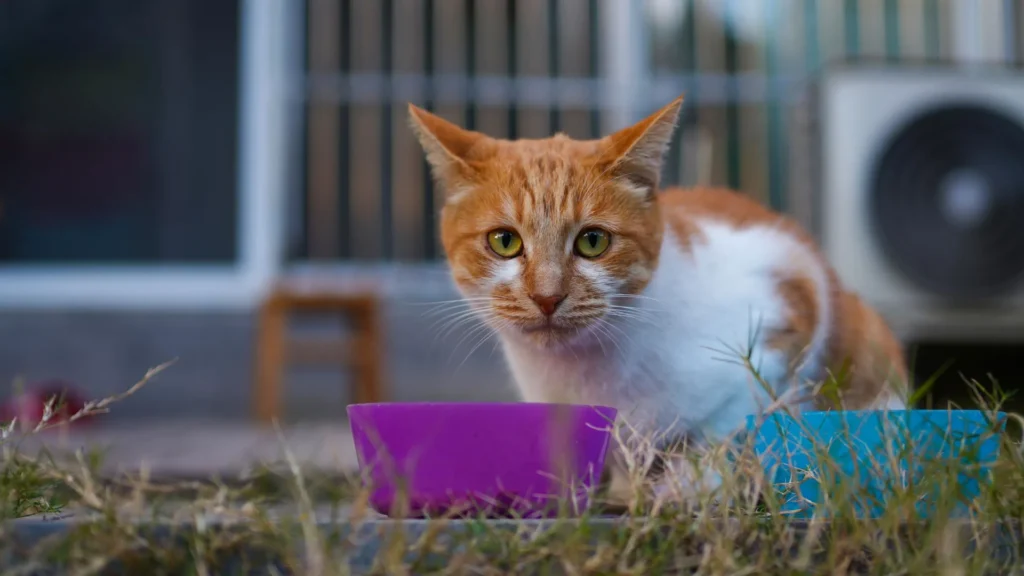
An overturned bowl on the pavement, a few kibbles scattered about, a plastic dish forgotten since the day before. It doesn’t take much for the presence of a cat colony in a courtyard or in front of a building entrance to become a source of conflict, or for a letter from the building manager to arrive in the mailbox.
Feeding community cats is an act protected by law, but it must be done following precise rules: always in a bowl, never on the ground, clearing away leftovers and leaving the area clean. These precautions protect the cats’ health, avoid attracting insects and rats, and remove arguments from those who would like to see the colony driven away.
In this guide, Rete Felina — the Animal Law Italia project that connects colony caretakers, municipalities and local health authorities (ASL) — explains how to set up the feeding point, how to choose between wet and dry food even in summer, what regional laws and municipal regulations say, and what judges have decided.
Why the way you feed matters
A well cared-for cat colony is one that goes largely unnoticed. Food left lying around, on the other hand, is noticed right away and brings concrete problems with it:
- insects and other animals: leftovers and open tins attract flies, ants, cockroaches and rats, as well as dogs and gulls;
- the cats’ health: food exposed to sun or rain spoils within a few hours and can cause digestive upset;
- relations with neighbours: smells, dirty dishes and leftovers are the main reason behind reports to the municipality and letters from building managers;
- risks for the colony: in the most serious cases, unsanitary conditions can prompt the health authority to intervene on the site, to the detriment of the very cats one is trying to protect.
Never food on the ground: always in a bowl
The first rule is also the simplest: food should be served in bowls or suitable containers, never poured onto the ground, onto steps, or under parked cars. Some practical pointers:
- Washable, stable bowls. Steel, ceramic or rigid plastic are best — easy to clean and hard to tip over. Avoid sheets of paper, aluminium trays and disposable plates, which the wind scatters around.
- A fixed spot. Always feed in the same place: the cats learn where and when to find their meal, and the area that needs keeping clean stays limited.
- A discreet spot. Away from entrances, pedestrian walkways and ground-floor windows, but also away from the shelters where the cats sleep and the areas where they relieve themselves. The US-based organisation Alley Cat Allies, an international reference point for the protection of community cats, also suggests quiet, low-visibility corners: the cats eat more calmly and the neighbours appreciate it.
- Never under cars. Besides dirtying the street, it puts cats in danger when the car pulls away.
- A small feeding station. A platform or a light, even homemade, shelter keeps food dry and away from ants. On public land, however, this must be agreed with the municipality, as we explain in our guide to winter shelters.
Timing, quantities and meal duration
Meals should be given at fixed times, during daylight, staying present until the cats have finished. It’s the simplest way to understand how much they eat and to avoid leaving anything behind.
Regular times
One or two meals a day, always at the same time and preferably in daylight: the cats will learn to show up punctually.
Collect the bowls after about half an hour
After 30 minutes, uneaten food starts attracting insects: that’s the moment to clear everything away.
Adjust portions with experience
If the food disappears in less than a quarter of an hour, you probably need to give more; if there’s always some left after half an hour, the portion is too generous.
Water stays out
The water bowl, cleaned and changed daily, can stay available at all times: even municipal regulations that require everything else to be cleared away acknowledge this.
Wet or dry food? And what about summer?
Both kibble and wet food are fine, as long as they are complete cat foods. What changes is how you manage them.
Dry food
Keeps well, doesn’t immediately attract insects, and is the most practical solution when you can’t stay around during the meal.
Wet food
Cats love it and it helps them take in fluids, but it spoils quickly and, if left in the bowl, soon becomes a magnet for flies and ants.
In summer, wet food is fine only if you stay until the cats have finished and remove the bowl straight away. In the heat it spoils quickly, and a dish forgotten in the sun is exactly what triggers complaints. If you can’t stay, measured portions of kibble are a better choice.
This doesn’t mean doing away with wet food. Alley Cat Allies actually considers it valuable in the warmer months, because cats drink little and get much of their fluids from food — one more reason to offer it in small portions, during the cooler hours, clearing away leftovers within three-quarters of an hour at the latest. During heatwaves, more water bowls in the shade, changed often, are also needed, as we noted when discussing the Regione Calabria ordinance against the heat.
Cleanliness: clear, wash, collect
Once the meal is over, the job isn’t done. Every time you feed the colony, leave the area as you found it, or cleaner.
- If you find droppings along walkways, remove them. It’s not an obligation — the Court of Cassation has ruled that the caretaker is not liable for it — but it is the colony’s best calling card.
- If other people leave food lying around near the colony, talk to them about it: a single, well-managed feeding point is worth more than many scattered dishes.
What the law says: feeding cats is protected, cleaning up is a duty
No law prohibits feeding community cats: protecting the colony also includes feeding it. However, those who feed it must do so without creating mess or hygiene problems. It’s a balance found, in different words, across all sources.
Law no. 281 of 14 August 1991 (L. 281/1991), Italy’s framework law on companion animals, protects cats living freely and prohibits mistreating them or driving them away from their habitat. Already in 1997, the Council of State (Section III, opinion no. 883 of 16 September 1997) had clarified that no law, whether national or regional, prohibits feeding ownerless animals in the places where they find shelter.
Regional laws: same rule, different wording
Regional laws, which you can find in our legislative database, express this principle with varying degrees of detail. Here are the most specific provisions:
- Puglia. Article 13, paragraph 6, of Regional Law no. 2 of 7 February 2020 requires those who feed colonies to comply with public hygiene and cleanliness rules, avoiding scattered food and keeping the area clean. The Puglia Region reiterated this in the Mola di Bari case.
- Calabria. Article 13 of Regional Law no. 45 of 3 October 2023 provides that the municipality identifies and marks the main feeding point, and that feeding cats may never be prohibited (paragraph 2). The caretaker also looks after the hygienic condition of the area (paragraph 4), and removable feeding structures may be placed on public land, ensuring hygiene and cleanliness (paragraph 5).
- Sicily. Article 22, paragraph 4, of Regional Law no. 15 of 3 August 2022 states that anyone may feed dogs and cats, in compliance with the municipal regulation and public hygiene rules, avoiding scattering food and cleaning the area. Preventing or obstructing care is prohibited, and anyone feeding regularly must restore hygienic conditions and report the location and number of cats to the municipality.
- Liguria. Under Article 8, paragraph 5, of Regional Law no. 23 of 22 March 2000, feeding colonies “cannot be prevented.” In case of dispute, the municipality designates a online service within the colony’s habitat.
- Abruzzo, Campania and Tuscany. These impose explicit cleaning obligations on those who feed cats: Article 18, paragraph 4, of Regional Law no. 47 of 18 December 2013 requires avoiding scattered food and constantly cleaning the area; Article 14, paragraph 5, of Regional Law no. 3 of 11 April 2019 and Article 35, paragraph 2, of Regional Law no. 59 of 20 October 2009 require the colony’s areas to be kept clean and tidy.
- The feeding point designated by the municipality. In Veneto, municipalities, after consulting the local health authority, identify the spaces designated for feeding cats (Article 16, paragraph 4, Regional Law no. 60 of 28 December 1993); in Tuscany, “suitable points” (Article 34, paragraph 2). In Lombardy the colony is registered in connection with its feeding point, and the caretaker also looks after the hygienic condition of the area (Article 11 of Regional Regulation no. 2 of 13 April 2017, implementing Regional Law no. 33 of 30 December 2009). In Friuli Venezia Giulia, colony areas are protected zones for the purposes of care and feeding (Article 22, paragraph 3, Regional Law no. 20 of 11 October 2012).
- Lazio. The regional guidelines approved by determination of 6 February 2023 include a handbook for colony caretakers: meals at fixed times, containers removed after each meal except for water, no food under cars, and in shared buildings, an agreed, clean space.
These rules apply everywhere, even where regional law doesn’t mention them. Other laws, such as those of Emilia-Romagna, Basilicata and Sardinia, do not set out specific provisions on feeding. But bowls, clearing leftovers and cleanliness stem from general rules on public hygiene and waste, and are repeated in almost identical terms by most municipal regulations for the protection of animals. Your municipality’s regulation may add further details, such as times or authorised points: always check it.
What judges have decided
- No to blanket bans, yes to rules. Administrative courts strike down ordinances that impose a blanket ban on feeding ownerless animals, but they recognise municipalities’ power to regulate how it is done. The Bari Regional Administrative Court (TAR Puglia, Bari, Section I), in judgment no. 1078 of 16 July 2018, held that feeding them is lawful if the food is placed in suitable containers, removed by whoever provided it: leaving them in place amounts to abandoning waste on public land. The same principle was reaffirmed by the Sardinia Regional Administrative Court (TAR Sardegna, Section I) in judgment no. 1134 of 23 September 2026. Both cases concerned dogs, but the reasoning applies to cats as well.
- Ordinances regulating feeding must be respected. In judgment no. 27109/2026, the Court of Cassation ruled that the caretaker is not liable for the cats’ droppings, but it did not consider unlawful a municipal ordinance that banned leaving food residues and allowed feeding colonies only for the time necessary, with immediate cleanup. Anyone who breaches it risks the administrative penalty set out in the ordinance.
- When management breaks down. In judgment no. 1299 of 23 April 2021, the Catania Regional Administrative Court (TAR Sicilia, Catania, Section IV) upheld a mayoral ordinance requiring cleanup, neutering and new feeding rules for cats kept in a private home and plot of land, after the local health authority had found a hygiene emergency. A different case from a well-managed colony, but one that shows how cleanliness is the first form of protection for cats.
In shared buildings: how to prevent disputes
A colony can live in shared areas, but the feeding point must be chosen and managed so as not to burden other residents. Article 1102 of the Italian Civil Code allows each co-owner to use shared areas provided they do not alter their purpose or prevent others from using them. The Milan Court, in judgment no. 23693 of 30 September 2009, classified the care of cats in shared spaces as falling within this legitimate use, and the Puglia Region confirmed that recognising a colony in a shared building does not require the building manager’s approval.
A few tips to avoid conflict:
- Agree on the feeding spot. Propose a specific spot to the building manager or at a meeting, away from entrances, garages and windows, explaining that it helps keep the cats in a defined, clean area.
- Stick to times and duration. Bowls removed after the meal are the most convincing proof that the colony causes no problems.
- Keep records. A few dated photos of the clean area, taken periodically, can be useful if a complaint arises.
- Respond calmly. If you receive a letter from the building manager, explain what you do and propose an agreement. Remember that cats cannot be driven away from their habitat: we will soon return to the topic of what a building’s co-owners can and cannot decide, with a dedicated article.
What to know about feeding a cat colony
It depends on your municipality’s regulation: many require all containers to be removed after the meal, except for water. Even where it isn’t prohibited, kibble left out for hours attracts ants, birds and other animals: in shared buildings it’s best to clear everything away.
Yes, but only if you stay until the cats have finished and remove the bowl straight away, because it spoils quickly in the heat. If you can’t stay, dry food is a better choice, and always leave fresh water in the shade.
A blanket ban is unlawful, as administrative courts have repeatedly stated, and some regional laws expressly rule it out. The municipality can, however, set rules on times, locations and cleanliness, which must be followed.
If you know who left it, talk to them and explain the rules: often it’s someone well-meaning who simply doesn’t know them. If the colony has a designated caretaker, let them know. If the problem continues or creates hygiene issues, report it to the municipality’s animal welfare office or to the local police: proper management also protects the cats.
Want more practical tips like these? Sign up for the Rete Felina newsletter: just a few emails, only when there’s news, with stories of protected colonies, guidance for caretakers, and ways to lend a hand.