
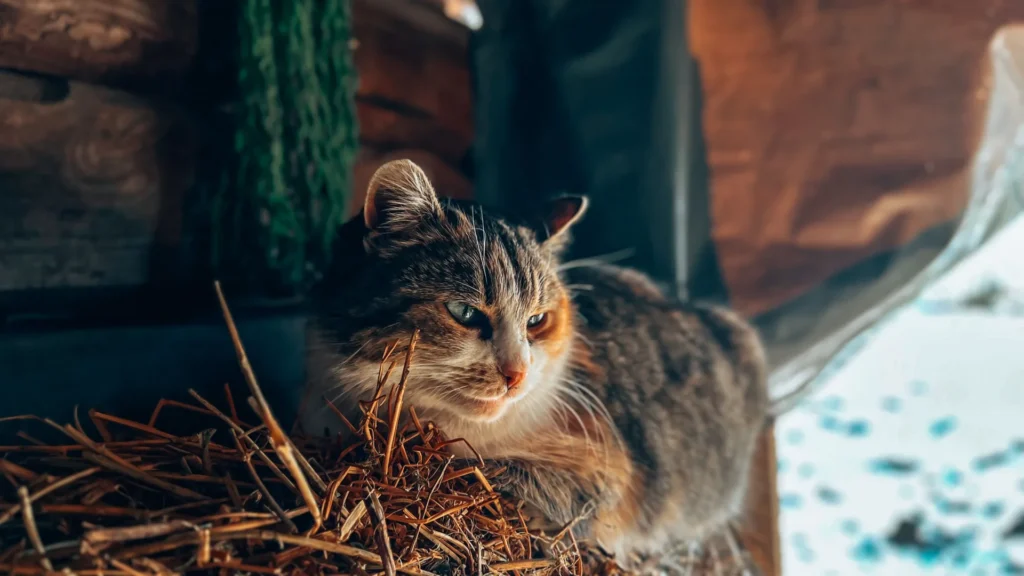
A night of freezing rain, wind gusting between parked cars, and the question every colony caretaker asks as winter arrives: will my cats make it through? Community cats cope well with cold, as long as they stay dry and sheltered from the wind. With little expense and a few precautions, you can do a lot to help them.
In this guide, we explain how to build a DIY shelter, how to organise food and water in the cold months, which dangers to watch out for, and what the law says when the shelter needs to be placed on the street or in a shared building.
Do community cats suffer from the cold?
Less than you might think, but not all cats cope the same way. In autumn, cats living outdoors grow a thicker coat and know how to find the most sheltered spots on their own: under cars, in building entryways, among hedges.
The real enemies aren’t low temperatures themselves, but dampness and wind. A wet coat loses much of its insulating power, and a soaked cat exposed to drafts gets cold quickly.
Some cats are more vulnerable and deserve extra attention:
- kittens born in autumn, who don’t yet have a full coat or fat reserves;
- older, thin, or recovering cats;
- cats with chronic conditions, such as respiratory infections, which cold and dampness make worse.
Anyone caring for what many still call stray cats — but who are, legally speaking, cats living freely — can make a real difference in one way above all: by providing a dry shelter.
How to build a DIY shelter for the cat colony
You don’t need to be a carpenter. The most common solution among volunteers, and one of the most effective, starts with a plastic storage bin with a lid — the classic storage box — lined on the inside with polystyrene panels.
Before you start building, keep in mind the rules that make a real difference:
- Keep it compact. A large shelter isn’t warmer: body heat disperses and the inside stays as cold as the outside. Alley Cat Allies, the US-based organisation that’s an international reference point for the protection of community cats, recommends a base of about 60 by 90 centimetres (24 by 35 inches) and a height of 45 centimetres (18 inches): enough to house three to five cats who can huddle together for warmth.
- A small entrance. An opening between 15 and 20 centimetres (6 to 8 inches) wide lets cats through, keeps out dogs and other animals, and limits rain and wind from getting in. If you can, add a second opening as an escape route: many cats won’t enter a shelter with only one way out.
- Straw, not blankets. This is the most important tip, and the least intuitive. Blankets, towels, cushions, and hay absorb moisture, get soaked, and end up freezing. Straw stays dry and lets cats dig themselves a cosy nest. Replace it whenever it gets dirty or damp.
- Raised off the ground. Even a few centimetres of clearance from the ground — using a pallet, bricks, or a wooden slat — insulates against cold and standing water.
- In a quiet spot. Place the shelter away from foot and vehicle traffic, with the entrance facing away from wind and the road, ideally near the place where the colony already gathers: cats are wary of change and stay attached to their own habitat.
Step by step
- Get a sturdy plastic container with a lid and some polystyrene panels, which can even be salvaged from packaging.
- Cut the entrance into one of the long sides, a few centimetres above the bottom, so the straw doesn’t spill out.
- Line the bottom and inner walls with the polystyrene, leaving the opening clear, and cover the inside of the lid too.
- Fill the shelter with straw, without packing it down.
- Close the lid and secure it with a weight or straps, so the wind doesn’t lift it off.
Some municipalities and associations distribute ready-made shelters to the caretakers of registered colonies: it’s worth asking. Anyone wanting to try their hand at wooden designs can find illustrated plans, in English, on the Alley Cat Allies website.
Food and water for the colony in winter
In cold weather, cats burn more energy to maintain their body temperature. In winter, portions can be a little more generous. Dry food is valuable because it doesn’t freeze; wet food should be served at room temperature and not left outdoors, where it would freeze solid.
Water is the trickiest part: a frozen bowl is an empty bowl. The water bowl should always be available, even in the cold months. A few tips:
- use deep, dark-coloured bowls, which warm up in the sun and freeze more slowly;
- place them somewhere sheltered, but never inside the shelter itself: spilled water would soak the straw;
- change the water at least once a day, more often on freezing days.
Caring for a colony also means respecting the people who live nearby. Food bowls should be removed once the cats have finished eating, leftovers cleared away, and the area kept clean: this is the best way to avoid friction with neighbours and to avoid attracting other animals.
Winter dangers for community cats
Cold isn’t the only risk of the season. Some dangers can be avoided with a simple habit, and it’s worth reminding neighbours and acquaintances too:
- Car engines. Looking for warmth, cats crawl into engine compartments or wheel wells of parked cars. Before starting the engine, knock on the hood a few times and check under the car.
- Antifreeze. Coolant has a sweetish taste that attracts animals, but it’s toxic even in small amounts. Keep it out of reach and clean up any spills immediately.
- Salt and de-icing products. These irritate paw pads and are toxic if licked: it’s best not to use them near the colony.
- Snow. Where it snows, regularly clear the entrances to the shelters: cats risk getting trapped inside or locked out.
Can I place a cat shelter on the street or in a shared building? What the law says
Law no. 281 of 14 August 1991, Italy’s framework law on companion animals, protects cats living freely: it bans mistreating them, requires that they be neutered by the veterinary service of the local health authority (ASL) and returned to their group, and allows organisations and associations to manage cat colonies in agreement with the local health authority (ASL). Many regional laws, which you can find in our legislative database, also prohibit removing cats from their habitat — meaning the place, public or private, where they live permanently.
Shelters themselves, however, generally aren’t specifically regulated. That’s why the answer mostly depends on where you want to place the shelter.
- On public land (sidewalks, flower beds, parks): you need to submit a request to the municipality, which can authorise the shelter through its own formal act. Some municipal animal welfare regulations already cover shelters and feeding stations: check your municipality’s rules and write to the relevant office before placing it. If you like, you can use the form on our website.
- In a shared building (courtyards, gardens, entrance halls): the colony can live in common areas even without the building manager’s approval, as confirmed by the Puglia Region in the Mola di Bari case. The shelter, however, is an object placed on shared property, and Article 1102 of the Italian Civil Code allows each co-owner to use common areas as long as they don’t change their intended purpose or prevent others from using them. The safest approach to avoid disputes is to propose it to the building manager or at a meeting of co-owners, explaining that it helps keep the cats in one clean, specific spot.
- On private land (a supermarket parking lot, a company area, a plot of land): you need the consent of the owner or whoever manages the area.
What if someone takes the shelter away? Bowls and shelters belonging to a colony aren’t abandoned waste: removing or damaging them can constitute a criminal offence, especially when it leaves cats exposed to the cold. Document it with photos and dates, and report it to the municipality and local police.
For a general overview of the rules on cat colonies, also read Cat colonies: what are the rules on Animal Law Italia’s online magazine.
In short: what to know about community cats in winter
Yes, as long as they stay dry and sheltered from the wind: in autumn their coat thickens and they know how to find natural shelter. Kittens, older cats, and sick cats are more vulnerable, and for them an insulated shelter can make a real difference.
Straw. Blankets, towels, and hay absorb moisture and end up freezing, while straw stays dry and insulates. Replace it whenever it’s dirty or damp.
On public land, you need to submit a request to the municipality. In a shared building, it’s best to reach an agreement with the building manager or the co-owners’ meeting, since the shelter occupies a common area. On private land, you need the consent of the owner or manager.
If the cat is injured, sick, or unresponsive, report it right away to the local police or the office designated by the municipality: emergency care for community cats is the municipality’s responsibility, even if the cat doesn’t belong to a registered colony. If the cat seems fine but has no shelter, you can offer one and ask the municipality whether there’s a registered colony in the area with a caretaker already looking after it.
If you look after a cat colony and the municipality, the building manager, or a neighbour is stopping you from protecting the cats from the cold, Rete Felina can help: tell us about your situation and we’ll support you in dealing with the authorities, including legal action when necessary.