
In 2016 Mariagrazia Distante launched I Felini di Puglia, the pilot project that over ten years has turned the protection of free-roaming cats from a principle written into law into everyday practice in dozens of municipalities. To celebrate this milestone, the Tenth Anniversary Manifesto (2016–2026) was created, bringing together the logos of more than 30 local groups across Puglia, Calabria and Basilicata.
In 2026 that experience found its natural evolution in Rete Felina, the Animal Law Italia project that connects colony caretakers, municipalities and local health authorities (ASL) to apply the rules protecting free-roaming cats consistently. Let’s retrace where it all began and what changes now.
Where it began: a good law left on paper
Law No. 281 of 14 August 1991 recognises the right of free-roaming cats to stay in their habitat and gives municipalities and local health authorities (ASL) the task of registering cat colonies and neutering the cats. A good law, but one that in many areas was not being applied.
In 2016, in the provinces of Brindisi and Barletta-Andria-Trani, the situation was emblematic. In the province of Brindisi, colonies had never been registered, because it was believed that accessing neutering required a municipal veterinary shelter (canile sanitario) and the mayor’s recognition. In Barletta-Andria-Trani, access to neutering was reserved for associations listed on the regional register, and the residents who cared for the cats could not request it.
The project started from there: forms to report colonies, specific requests to local health authorities, local groups — such as I felini di Barletta and I felini di Brindisi e provincia — able to engage with their own local authorities on their own. This is how, for the first time in Puglia, municipal, provincial and regional networks of colony caretakers came to be.
Ten years of concrete results
Over ten years of uninterrupted activity, and always free of charge, the project has overcome the isolation in which colony caretakers often work and has introduced tools that are now a model:
- Censuses and neutering. Thorough monitoring across the area and support for local authorities in birth-control plans, with neutering finally activated at local health authorities (ASL).
- Recognition from municipalities. Six municipalities — Brindisi, Ceglie Messapica, Francavilla Fontana and San Vito dei Normanni in the province of Brindisi, Putignano and Alberobello in the province of Bari — were the first to adopt a council resolution joining the project. Two more have joined over the years.
- The caretaker role, trained and recognised. The Cat Caretaker Card and the Cat Caretaker Handbook, practical tools that received the moral patronage of the local health authorities (ASL) of Bari and Brindisi.
- Feeding stations that combine welfare and tidiness. The GattoFioriera and the GattaPanca are pieces of street furniture designed to feed and shelter cats while keeping public spaces clean. The first GattoFioriere arrived in 2020 in Brindisi and Latiano (BR), in 2021 in Putignano (BA) and in 2026 in Alberobello (BA).
- Forms and traceability. Procedures to document every intervention and geo-mapping of colonies in the area.
- Beyond Puglia. In 2021 the project reached Lamezia Terme (CZ), in Calabria, and later Matera, in Basilicata.
The common thread is always the same: protecting cats and keeping public spaces tidy are not in conflict. Those who care for a colony have rights, but also duties — bowls removed after feeding, no leftover food, a clean area — and the project has always kept these together.
The Tenth Anniversary Manifesto
The Tenth Anniversary Manifesto is a visual summary of these ten years: it brings together the logos of the local groups born from the project, from I felini di Brindisi to I felini di Ginosa, through to I felini di Lamezia Terme in Calabria and I felini di Matera in Basilicata, giving an identity to free-roaming cats and to those who care for them.
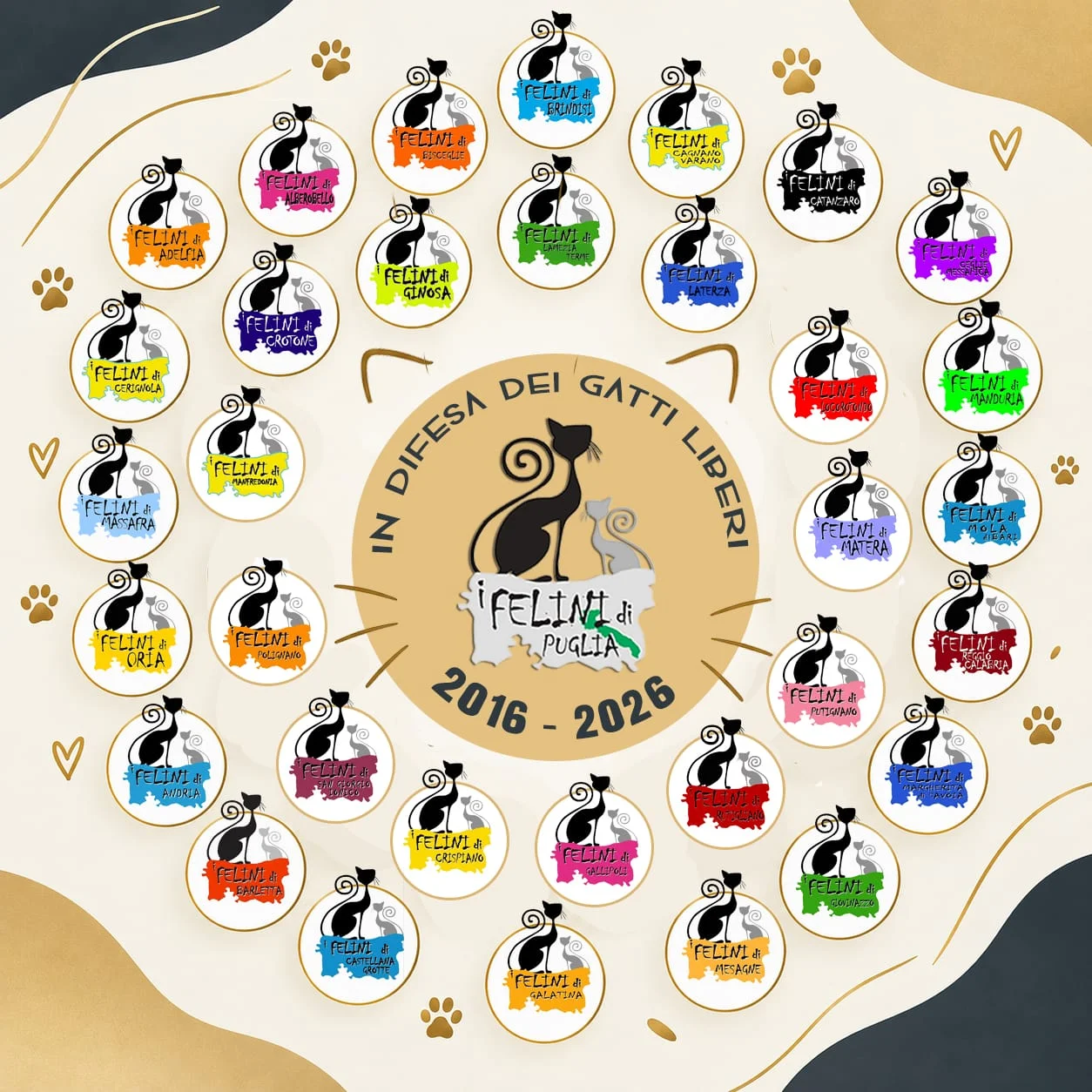
It pays tribute both to the groups on the front line today and to the historic groups that have completed their mission, achieving stabilisation and optimal management of the colonies in their area. This too is a result: a colony that has been registered, neutered and cared for is a colony that no longer needs emergency intervention.
“Ten years ago I started this journey to turn the principles of Law 281/91 into a shared, everyday practice,” says Mariagrazia Distante, the project’s founder. “Today we celebrate the application of the laws protecting free-roaming cats in areas that have benefited from this revolution thanks to the synergy between responsive institutions and hundreds of residents who care for free-roaming cats with dedication. The Ten-Year Manifesto is visual proof of how much a project run free of charge can positively impact animal welfare and the upkeep of our municipalities.”
From I Felini di Puglia to Rete Felina
In 2026 Animal Law Italia took up the legacy of I Felini di Puglia and relaunched it as Rete Felina, entrusting its leadership to the same Mariagrazia Distante. If the 2016 project is the blueprint, Rete Felina has a broader goal: to bring the results already achieved locally to a national scale.
There are two main differences. The first is legal support: alongside field experience, there is now the team of lawyers at Animal Law Italia, who step in when a municipality or local health authority fails to apply the rules: requests for clarification, formal notices and, when necessary, legal action. Some results are already documented in the Our Cases section (in Italian), such as the colony in a shared building in Mola di Bari (in Italian), where the Puglia Region confirmed that the building manager’s approval is not required.
The second is the training team, dedicated to those who care for colonies: together with cat behaviour experts, it prepares materials and sessions for caretakers, such as the guide Cat Body Language (in Italian).
Today Rete Felina is active in four regions — Puglia, Calabria, Basilicata and Sardinia — and aims to grow further. The full story, step by step, is on the History of the Project page (in Italian).
If you care for a cat colony, are part of a local group, or work for a municipality or a local health authority, Rete Felina can bring ten years of experience to your area too: join the network (in Italian) and let’s build the next decade of protection for free-roaming cats together.