
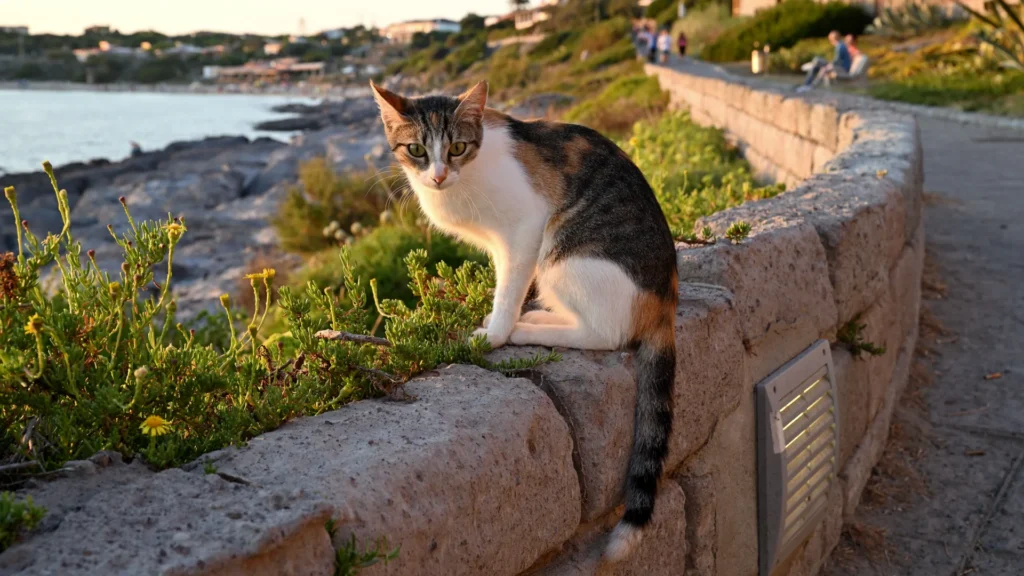
As of November 2026, Rete Felina is active in Sardinia too. Colony caretakers on the island can now turn to Rete Felina, the Animal Law Italia project that connects colony caretakers, municipalities and local health authorities (ASL): they can report problems to the legal team and keep their colony’s record online.
This isn’t random growth. As we explained in the article on the goal of getting free-roaming cat laws fully enforced in the South (in Italian), the laws that protect cats already exist: our job is to get them respected, starting with the areas where the problem is felt most.
From two to four regions in six months
Rete Felina was launched (in Italian) in May 2026 in Puglia and Calabria, building on ten years of experience from the pilot project “I Felini di Puglia”, started in 2016 by Mariagrazia Distante. Since then the network has grown:
- May 2026, Puglia and Calabria: the regions where it all began, with around 50 municipalities in Puglia involved in the pilot project and the experience of Lamezia Terme (CZ);
- September 2026, Basilicata: the group “I felini di Matera” was born in Matera;
- November 2026, Sardinia: the network reaches the island.
Today Rete Felina counts dozens of local groups and a growing number of municipalities that have formally joined the project with a council resolution, with the option of going beyond simple law enforcement — for example by issuing a caretaker card and handbook, installing feeding stations for community cats, and other initiatives to improve urban coexistence between cats and people.
Why we’re starting in the South
The basic rules are the same across Italy. Law 281 of 14 August 1991 bans mistreating cats living freely and establishes that they must be neutered by the health authority and returned to their group (art. 2, paragraphs 7 and 8). Each Region then has its own implementing law.
What changes from one area to another is enforcement. Censuses that never start, neutering that has stalled or is insufficient, municipalities that don’t respond to requests for colony recognition: these are the problems colony caretakers report to us most often, and in the Southern regions they weigh more heavily. That’s why we chose to start here.
We’re not asking for new laws: we’re asking that the ones already in force be applied, with the same rules for everyone, whether a colony is in Brindisi, Matera or Cagliari.
What colony caretakers find in Sardinia
In Sardinia the matter is governed by regional law 21 of 18 May 1994. Article 14 is dedicated to community cats and states three clear things:
- it is forbidden to mistreat them or remove them from their habitat;
- they must be neutered by the relevant ASL and returned to their group;
- they can only be euthanised if seriously ill or incurable, and the decision rests solely with the ASL veterinarian.
From this month, anyone caring for a colony on the island can use Rete Felina’s tools. At sportello.retefelina.it they can keep the colony’s record for free and, if their group has joined the network, report a problem to the legal team: lawyers respond and, when needed, write to the authorities on behalf of Animal Law Italia. We explain how it works, step by step, in the guide to Rete Felina’s legal service (in Italian).
The first reports have already come in: colony registration requests left unanswered in several parts of Sardinia, and the choice, reported by local organisations, not to perform ear-tipping (in Italian) as part of the two-year neutering programme run by ASL n. 5 of Oristano. Ear-tipping is the removal of the tip of the ear that makes already-neutered cats visually recognisable. We don’t yet have confirmation that sessions under this programme have started, or that procedures have already been carried out without ear-tipping. We’re following up on these issues together with local organisations.
An important moment for Sardinian cats
Rete Felina arrives in Sardinia at a favourable time. With resolution n. 50/57 of 15 October 2026, the regional government approved a three-year neutering plan for 2026, 2027 and 2028, worth 500,000 euros a year. Of this, 100,000 euros a year is earmarked for procedures on cats in cat colonies, listed in the plan as “registered”; the lead authority, which will have to publish the notices, is ASL n. 1 of Sassari.
Credit should go to the Region for allocating dedicated resources to colonies. The reference to “registered” colonies, however, raises a concrete issue: in many municipalities recognition requests remain stalled for months, sometimes for years, and the colonies affected risk being left out of the plan through no fault of their caretakers.
On this point, on 29 October 2026 twenty Sardinian organisations wrote to ASL n. 1 of Sassari, copying the Region, asking that all unowned free-roaming cats be included in the plan, whether or not their colony is already registered. This is a position we share: the law protects cats living freely, and we’re asking that registration delays not prevent access to these procedures. We’re therefore asking the Region to clarify the eligibility of all free-roaming cats and, failing that, at least of colonies with a pending registration request, before the notices are published.
A practical tip: if you care for a colony in Sardinia and haven’t had it registered yet, submit a request to the municipality and the ASL. If you’ve already submitted one and haven’t had a reply, follow up in writing and keep the receipts. If the municipality doesn’t respond or denies recognition, report the case to us.
And in Basilicata
In Basilicata the relevant law is regional law 46 of 16 November 2018. Since September 2026, colony caretakers in Basilicata have been able to rely on the network, starting with the group “I felini di Matera”, with the same tools active in the other regions: the colony record, reports to the legal team, and support in dealing with municipalities and ASLs.
If you care for a cat colony in Sardinia, Basilicata, Puglia or Calabria and something isn’t right, Rete Felina can help you: sign up and tell us about your case and we’ll support you in dealing with the authorities, up to legal action when necessary. If you represent a municipality or an organisation and want to work with us, join the network (in Italian).